
Data creates news and, for that reason, there is a technique known as newsmaking, which consists of creating news through studies that generate data. However, not all brands can afford a project of this scale, so today we explain how to use third-party studies to appear in the media with your personal brand. Because if you stay up to date with your sector or know how to use the right tools, you can take advantage of the situation and position yourself as an expert voice on topics related to the data presented by journalists. Let’s get to it, and at the end we’ll tell you how you can create your own study if you have the necessary resources.
What do we mean by a third-party study?
We are referring to news items that often state “according to a study by…” and are attributed to different organizations such as a university, a brand’s research department, a consultancy, etc. In other words, these are usually data provided by large companies or institutions that have made a significant investment in this type of initiative.
The formats they are known by can include studies, barometers (if it is a recurring publication), surveys, or reports, among other names.
How can I appear in the media with my brand using these studies?
The first and most important thing is to stay on top of current affairs. In other words, be aware of the study as soon as it is released. This way, you can react quickly.
Once you have the information from the study, analyze it and extract a couple of ideas that you could discuss with a journalist. These could be explanations of certain conclusions from the study, points where you may differ based on your perspective as a specialist, or perhaps a “local angle” (showing a local example, in your region or in Spain) if it is an international study.
With this in hand, you can approach journalists by explaining that, in relation to the recent publication of the “XXX” study, you would like to comment on a few points (which you then mention).
If you do not have specific points to comment on from the study, you can still contact the journalist by mentioning that, now that a particular topic is being discussed as a result of the study, you could complement the information or take part in any upcoming articles they may be planning (without needing to specify any analyzed points).
In short, if you act proactively, you have two options. The first is to propose commenting on specific aspects of the study, and the second is to put yourself forward as an expert voice on topics related to that study within your sector.
On the other hand, if you are in constant contact with journalists, as we are, opportunities can also arise reactively. In other words, it may be a journalist who approaches you to take part in an article they are writing based on a study.
3 real examples from Real
To make it clearer, here are three examples of clients with whom we have leveraged third-party studies to bring a brand into the media.
- Txell Costa, business mentor and expert in female leadership, was very alert and wanted to comment on the concept of she-cession that appeared in a study by the consultancy McKinsey. It was not her study, but being able to comment on that aspect allowed us to be proactive and secure her a nationwide interview on Onda Cero. You can listen to the interview on the Onda Cero website.
- Something similar happened with psychologist Daniela Constantin. We proposed a series of topics to a journalist and, coincidentally, she was working on another one based on a study from Harvard University. She therefore suggested that Daniela take part in that article for Mujer, the women’s section of 20minutos.
- Finally, while talking with a journalist from elEconomista about travel-related topics (specifically a getaway to a hotel with a great spa), she herself told us—because she knows we are also specialized in tourism—that she was working on an article based on a BBVA Research study on the impact of climate change on the Spanish tourism sector, and asked whether we would like to participate with one of our clients. Of course, we took the opportunity and secured comments from Eva Ruiz, coordinator of the tourism department of the Sant Josep de sa Talaia town council in Ibiza, who was able to highlight one of their main initiatives to reduce tourism seasonality in the municipality. Here you can read the full article in elEconomista.
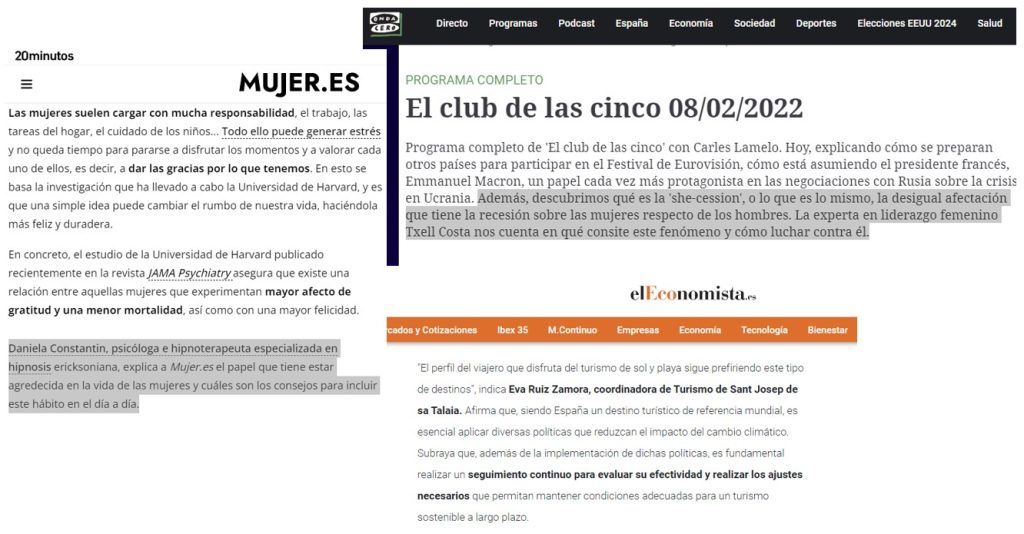
In summary, neither Txell Costa, nor Daniela Constantin, nor Eva Ruiz from Sant Josep de sa Talaia invested in producing a study, yet they all achieved coverage in highly relevant media outlets thanks to third-party studies.
Extra: you can also create your own study to appear in the media
Not long ago we told you about the launch of a new service designed to help you appear in the media through this newsmaking tool. We have already used it with other personal brands such as Silvia Bueso and it has been a great success. So, if you are interested in the idea of creating your own study, report, or barometer to appear in the media and thereby differentiate and elevate your brand, you can count on us.
You can find all the information about the service at this link and, of course, you can contact us so we can analyze your case in detail and see whether this technique is right for you. Remember that you can book a virtual coffee with us via this calendar.
Were you familiar with the technique of using a study or report to appear in the media? What do you think about leveraging studies from large companies and institutions to promote your personal brand? Would you consider it, or would you prefer to create your own study? Tell us in the comments!
Leave a comment